A Short Walking Tour of Cambridge Oddities You Can See Between Sessions
Stop. Put down the conference lanyard and step away from the lukewarm coffee. There is a common misconception among business travellers and academic visitors that seeing the real Cambridge requires a sabbatical, a bicycle, and three days of free time.
You might think that because you are stuck in seminars from 9:00 AM to 5:00 PM, your experience of this historic city is doomed to be limited to the view from your hotel window and the interior of a lecture hall. You are wrong.
Here is the reality: ‘Conference Zombie’ syndrome is real, and the only cure is fresh air and history. You are currently standing on some of the most intellectually hallowed ground on Earth, and ignoring it for a PowerPoint presentation is technically a crime against travel.
You don’t need a full day; you just need a strategy. The historic center of Cambridge is surprisingly compact, dense with oddities, and perfectly designed for the time-poor traveler.
We call this the ‘Brain Break.’ It is the art of injecting thirty to sixty minutes of high-density culture into a schedule packed with networking and note-taking. It is about prioritizing the strange, the beautiful, and the famous landmarks that sit literally around the corner from your meeting venue.
In this guide, we have curated a DIY short walking tour of Cambridge that focuses exclusively on the quirky highlights—the things you can photograph, marvel at, and understand in under ten minutes each. From a clock that eats time to a bridge that defies gravity, these are the oddities that make for perfect dinner party anecdotes when you get back home.
Ready to salvage your trip? Let’s lace up your comfortable shoes. By the time you finish reading this, you’ll have a roadmap to seeing the best of the city without missing a single keynote speech. And if you realize you want someone else to manage the time-keeping while you enjoy the sights, we’ll show you how a professional guide can actually save you even more time.
1. The Corpus Clock: The Time-Eating Monster
Why it fits your lunch break
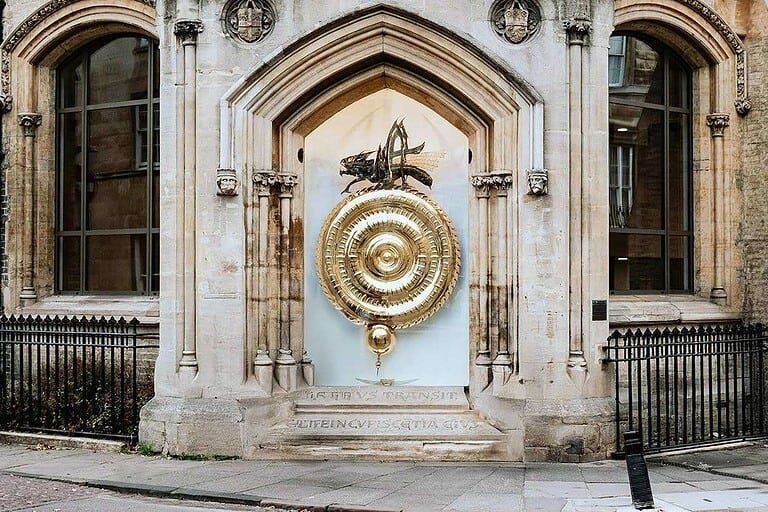
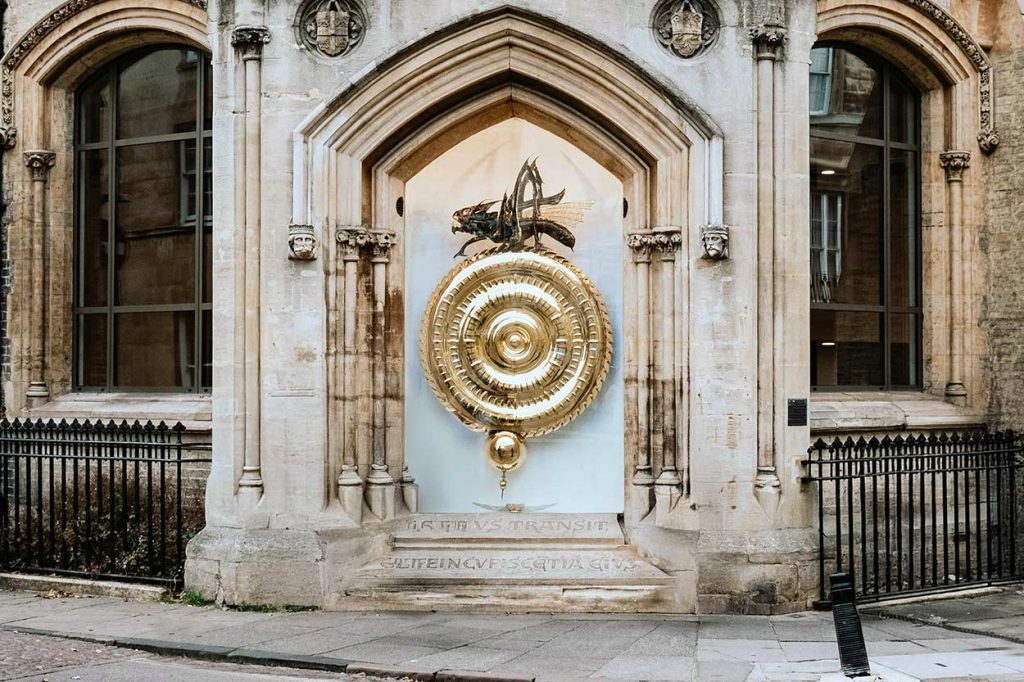
If you only see one strange thing today, make it this. Located on the corner of King’s Parade and Bene’t Street, the Corpus Clock is impossible to miss.
There are no tickets to buy and no lines to wait in. You can view this gold-plated spectacle directly from the sidewalk.
Atop the clock sits a terrifying creature called the Chronophage, or “Time Eater.” It looks like a demonic grasshopper. Every minute, its jaw snaps shut, symbolically eating a second of your life that you will never get back.
Installed in 2008 and inaugurated by Stephen Hawking, this masterpiece is worth over £1 million. It serves as a beautiful, albeit slightly terrifying, memento mori.
It is a stark reminder to the busy conference attendee: Time is fleeting. Don’t spend all of it checking emails.
2. The Mathematical Bridge: Newton’s Myth vs. Reality
A geometry lesson in 5 minutes
Head toward Silver Street Bridge for a free, perfect view of the Mathematical Bridge. It connects two parts of Queens’ College.
You will likely hear a passerby claiming Isaac Newton built it without a single bolt. They will say that students took it apart and couldn’t put it back together, so they had to use bolts.
This is pure fiction. Newton died nearly 22 years before the bridge was constructed. It was actually designed by William Etheridge in 1749.
However, the reality is still an engineering marvel. It is built using a method called “tangent and radial trussing.”
It looks like a pile of matchsticks held together by willpower, but it is actually sophisticated engineering. You can snap a photo and debunk the myth for your colleagues in under five minutes.
3. The Eagle Pub: Where DNA Was Announced
The most important pint in history
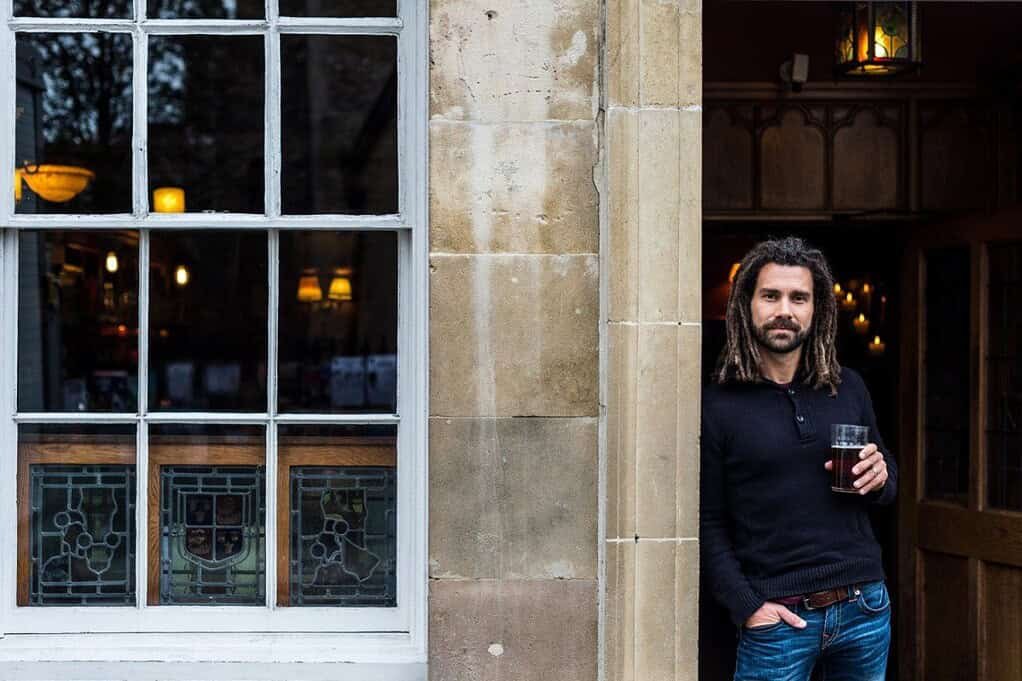
Walk back toward the center to find The Eagle on Bene’t Street. You don’t need to commit to a full meal here.
Just pop your head in for a quick peek at two specific things. First, look at the ceiling of the RAF bar. It is covered in graffiti burned onto the surface with lighters by WWII pilots.
Next, look for the plaque near the middle of the room. This is the exact spot where Francis Crick and James Watson interrupted the lunchtime patrons on February 28, 1953.
They announced they had discovered “the secret of life”—the structure of DNA. For anyone interested in a short walking tour Cambridge history lesson, this is ground zero for modern science.
4. The Round Church: A Crusader’s Relic
900 years of history in one glance
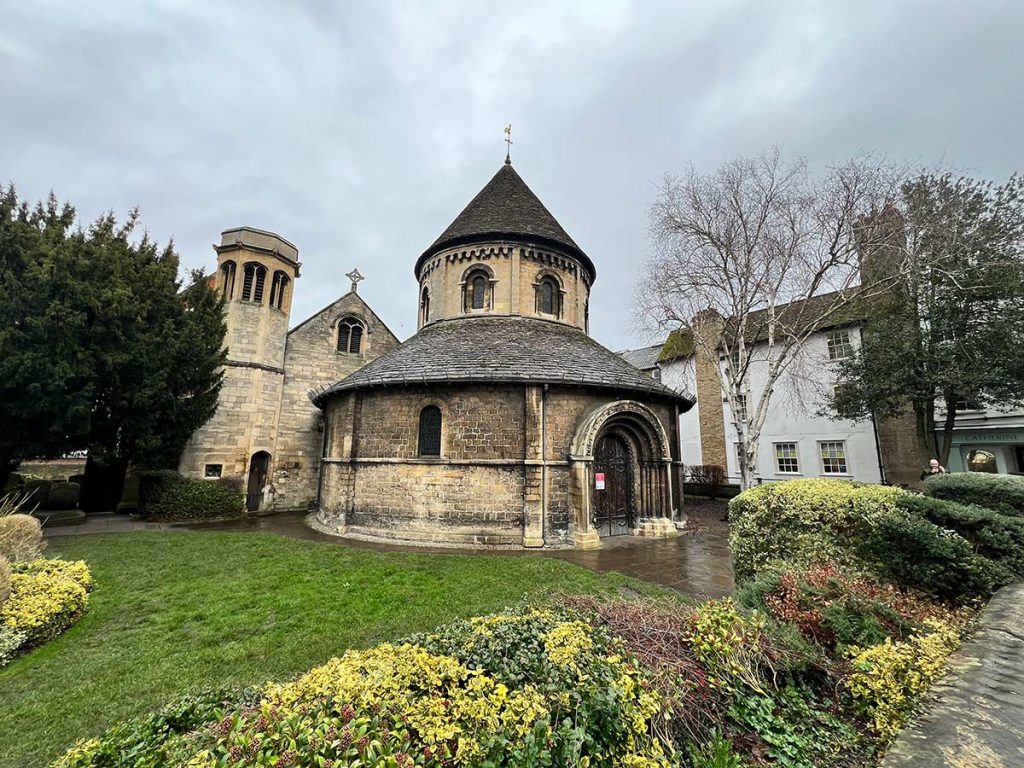
Continue down the street to the Church of the Holy Sepulchre, commonly known as the Round Church. You will notice immediately that it looks nothing like the soaring Gothic college chapels nearby.
This is one of only four medieval round churches still in use in England. It dates back to around 1130 AD.
The stout, Norman architecture feels heavy and ancient. It was built by a fraternity inspired by the circular Church of the Holy Sepulchre in Jerusalem.
Standing in front of it feels like stepping back into the Crusades. It is a striking visual contrast to the rest of the city and takes only moments to appreciate from the exterior.
5. Trinity’s Apple Tree: The Descendant of Gravity
Standing under scientific royalty
Just outside the Great Gate of Trinity College on Trinity Street, you will find a small garden area. In it stands a rather unassuming apple tree.
This is the ultimate “nerd selfie” spot. While the original tree that allegedly dropped an apple on Newton’s head was at his home in Lincolnshire, this is a direct descendant.
It was grafted from the original stock and planted here in 1954. You are standing in the shadow of the same genetic material that sparked the theory of gravity.
It is a quick stop, but it connects you instantly to the academic heavyweight history of the university.
6. The ‘Power Hour’ Route Logistics
Connecting the dots efficiently
To make this work, you need to move in a logical circle. Backtracking wastes time.
Here is your optimized route:
- Start at Silver Street Bridge (Mathematical Bridge).
- Walk up to The Eagle Pub (DNA plaque).
- Turn the corner to King’s Parade (Corpus Clock).
- Head down Trinity Street (Newton’s Apple Tree).
- Finish at The Round Church.
If you maintain a brisk walking pace and spend 5-8 minutes at each stop, you can complete this circuit in 45 to 50 minutes. It leaves you just enough time to grab a coffee before your next seminar begins.
7. Want the Stories Without the Stress?
Why a guided tour is the ultimate time-hack
We love a DIY adventure. But if you are staring at Google Maps trying to figure out which way is north, you are wasting precious brain break minutes.
A professional guide knows the shortcuts. They know the gate codes. They know the hidden history that isn’t written on the blue plaques.
Don’t spend your break stressed about navigation. Let a local steer you right to the good stuff. You can see more in 90 minutes with an expert than most people see in a full day on their own.
Check out our consolidated schedules at cambridge.tours. Maximize your limited free time and go home with stories that are actually worth telling.
Frequently Asked Questions
Can I do this tour in business shoes?
Yes. The route is entirely paved and flat. However, Cambridge cobbles can be tricky for stilettos, so watch your step.
Do I need to pay to see these landmarks?
No. All the landmarks listed in this specific route are viewable from public streets or free-access areas.
What if it rains?
Cambridge is lovely in the rain, but bring an umbrella. The Eagle Pub and the Round Church offer indoor shelter if a sudden downpour hits.
Is this suitable for a lunch break?
Absolutely. The route is designed to be completed in under an hour, perfect for the standard conference lunch gap.